Antagonism and Synergism: War and Peace Between Elements
In the soil and around plant roots, there is an invisible yet remarkably beautiful flurry of activity. Microorganisms are in constant communication and interaction with one another. Sometimes one suppresses another; sometimes they join forces. Antagonism is when one organism slows down or prevents the growth and development of harmful organisms that could cause disease in the plant. (1)
Then there is synergism: two or more microorganisms come together and support each other, creating a far greater effect than they could on their own. They work almost like a team, forming a powerful team beneath our soils. (2) Soil structure, pH, the antagonistic and synergistic effects of nutrients on one another, biological factors… All of these directly affect how, and how much, plants can take up nutrients. pH in particular is one of the most critical points. If the soil has an excess of H⁺ ions, it is acidic; if it has an excess of OH⁻ ions, it is alkaline. If the two are in balance or close to it, the soil is considered neutral. There is one detail here that is especially important for micronutrients: almost all micronutrients are metals. And metals turn into metal hydroxides under alkaline conditions. In this form, their uptake by plants drops to almost nothing. For example, zinc (Zn) or iron (Fe) in the soil combine with hydroxyl ions to form compounds such as Zn(OH)₂, Fe(OH)₃ or Fe(OH)₂. Unfortunately, these compounds are not available to the plant. If you are growing on high-pH soil and using drip irrigation, slightly acidifying your fertilizer solutions can make nutrient uptake easier. Chelated formulations can also be preferred for micronutrient applications. Acidic conditions upset many balances in the soil. For example, in acidic environments nitrification reactions slow down, which reduces nitrogen (N) conversion. Molybdenum (Mo) also turns into a form plants cannot take up.
There is more: in acidic conditions, the solubility of some nutrients increases and they can reach toxic levels in the plant. These excessively dissolved elements can both harm the plant and suppress the uptake of other nutrients, leading to deficiencies. In acid-sensitive crops such as barley and sugar beet in particular, the root system can be seriously damaged. An excess of one element in the soil usually prevents the plant from taking up another. This is called an antagonistic effect. For example, an excess of calcium (Ca) in the soil can cause iron (Fe) deficiency in the plant, and an excess of phosphorus (P) can cause zinc (Zn) deficiency. In this case, calcium has an antagonistic effect on iron. Then there is the opposite, which we call a synergistic effect. Here, plant nutrients support each other and, in the right proportions, increase each other's uptake and effect. They work hand in hand to serve the plant better. Various substances in the soil can hold ions on their surfaces through electrical attraction. Ions held in this way can later be taken up by plant roots through ion exchange. Likewise, ions released from the roots can pass into the soil solution through the same mechanism. (3)
Plant Nutrients and Their Effects
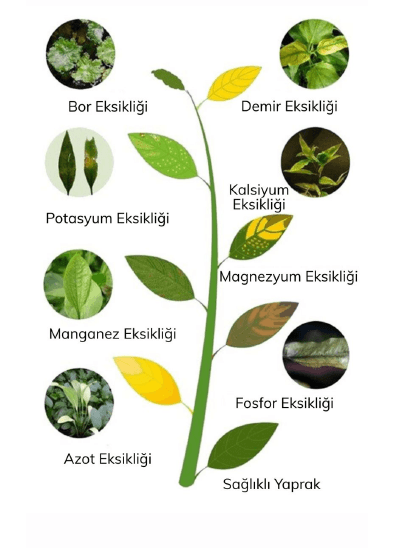
Nitrogen is perhaps the most important nutrient of all, which is why it is one of the most commonly used elements in fertilization. Nitrogen (N): When nitrogen is deficient, plant growth and development slow down quickly and the plant generally stays small and spindly. The number of shoots decreases and shoots are shorter than normal. If the deficiency progresses, shoots curl and grow downward. Leaves become smaller, drop prematurely and show severe chlorosis (yellowing). In this situation the plant releases senescence hormones, root development weakens and thin, weak roots appear. Because nitrogen is mobile within the plant, deficiency symptoms show up first on older leaves.
But too much nitrogen is not good either. Excess nitrogen can cause many problems, such as abnormal elongation, softening of tissues, lodging (the plant falling over), lower disease resistance, late flowering, shorter shelf life, reduced sugar synthesis, early fruit drop and more storage diseases. Plants mostly take up nitrogen in these forms: NO₃⁻ (nitrate), NH₄⁺ (ammonium) and NH₂⁻ (amine). (4)
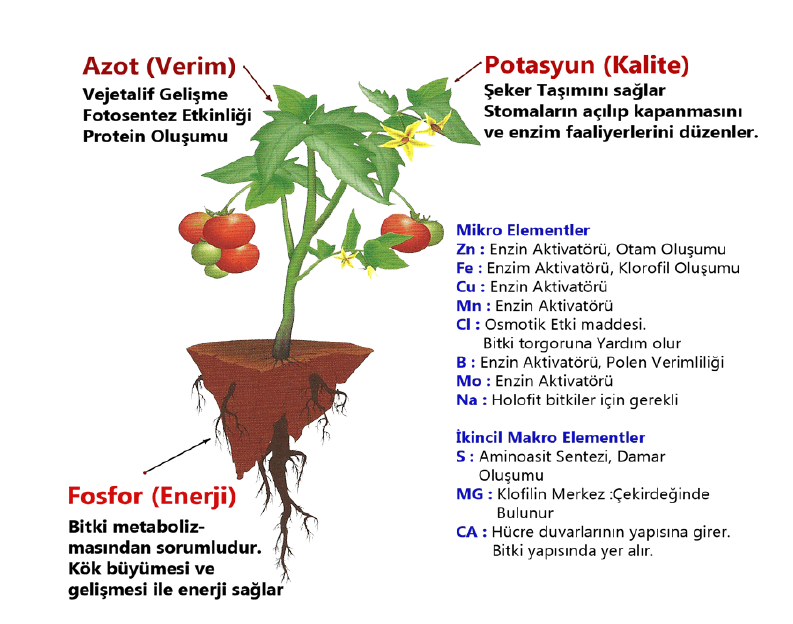
Phosphorus (P): The total amount of phosphorus in soil usually ranges between 0.02% and 0.14%. In other words, it is less abundant than nitrogen and potassium, which is why it is one of the most widely used elements in fertilizers. The organic phosphorus found in plant and animal residues in the soil is actually the soil's phosphorus reserve.
But for plants to benefit from it, the organic matter has to break down and decompose. Phosphorus is part of the structure of proteins in plant cells and plays a critical role in flower and fruit formation. It contributes to the formation of proteins and oils in the plant, helps convert starch into sugar and improves the plant's uptake of potassium. Its greatest effect, however, is on root system development. By helping roots grow and spread better, it increases the plant's capacity to draw on the soil. It also speeds up maturity: in phosphorus-rich soils, seed formation starts earlier and the plant matures faster. It supports the plant's overall development and increases its resistance to diseases and pests. So what happens when phosphorus is lacking? The root system and the plant as a whole stay small, and yields fall. In cereals, tillering decreases and grain yield drops. The plant may turn a darker green than normal. These color changes usually start on older leaves and are especially visible on the underside of the leaves. Extreme cold, drought, pesticide applications and very high or very low pH also make phosphorus uptake harder and lead to deficiency symptoms. Phosphorus deficiency reduces yields, and fruits stay smaller than normal. Potassium (K): The total potassium content of soils usually ranges between 0.3% and 3%. Potassium is found in greater amounts in the young, fast-growing parts of the plant, such as young leaves, root tips and buds, and in lower amounts in older tissues. Potassium is constantly on the move inside the plant, transported from older organs to young tissues where demand is higher. In some plants, the stems and leaves can even contain more potassium than the grain. Potassium contributes positively to both the quantity and the quality of the crop. Especially when excess phosphorus in the soil causes early ripening, potassium balances this out and brings ripening back to its normal timing.
It also increases fruit firmness and raises oil, starch and sugar content. It improves quality traits such as color, taste and aroma in fruits and vegetables. So how can potassium deficiency be recognized? The symptoms vary from plant to plant. For example: ● In corn, yellowing and drying start at the leaf tip and spread toward the edges. These brownish areas eventually kill the whole leaf. ● In alfalfa, white spots form on the edges of older leaves; these areas then dry out and the leaves curl. ● In general, plants lacking potassium show "tobacco-colored" scorching on the tips and edges of older leaves. Potassium deficiency reduces the plant's resistance to drought, cold and disease. It also impairs fruit and crop quality and shortens storage life. Calcium (Ca): In plants, calcium is especially abundant in the leaves. Unlike phosphorus and potassium, there is more calcium in older leaves than in young ones. It is found in the structure of cell membranes, in the protoplasm and in some proteins. Calcium plays an important role in cell division, in increasing seed germination rates and in giving the plant a strong structure. It also reacts with harmful substances and elements in the soil, precipitating them and rendering them harmless. Calcium helps the plant build a healthy structure by making its leaves and stems sturdier. Calcium deficiency is more common in acidic soils. In such cases, legumes such as alfalfa and clover grow slowly, give low yields and have a lower protein content. The most visible symptom of calcium deficiency appears in fruit. Especially as fruit set begins, dirty yellow and grey and then brown and blackish spots and lesions form at the blossom end of the fruit.
Magnesium (Mg): Magnesium is one of the cornerstones of plant life. It speeds up the uptake of phosphorus from the soil and, most importantly, it is always part of the structure of chlorophyll. Every chlorophyll molecule contains one Mg atom; in other words, magnesium is essential to the remarkable pigment that gives leaves their green color. Magnesium is also abundant in seeds and is a critical element for oil formation. Magnesium deficiency shows up as yellowing of the leaves, especially in vegetables. Sulfur (S): Sulfur is part of the structure of proteins in the plant and is needed for chlorophyll formation. It also supports root growth and, in legumes, helps form the root nodules that fix atmospheric nitrogen into the soil. Sulfur deficiency produces symptoms similar to nitrogen deficiency: plants grow slowly and the leaves turn a yellowish green. Micronutrients and Their Roles in the Plant: Micronutrients are minerals that plants need in small amounts but that are just as critical. In general, they take on the following roles in the plant: ● They become part of plant tissues, making them one of the plant's basic building blocks. ● They act as catalysts, helping speed up chemical reactions in the plant. ● They play an active role in oxidation–reduction (electron transfer) processes in the plant. ● They help regulate the plant's acid–base balance.
● They influence and regulate the uptake of other nutrients by the plant. In short, micronutrients are indispensable for healthy plant growth and development.
Biotechnologist, Yeşim VAROL